Gold at USAW U25 National Championship for Collegiate Weightlifter
by Ivan Escott
Jul 9, 2026
•7 minutes
INTRODUCTION
This case study examines the progress of a 20-year-old male athlete specializing in Olympic weightlifting over a structured 9-month training program. This athlete followed the Olympic weightlifting training plan in Peak Strength over various competition peaks.
The training plan, consisting of 3-4 training sessions per week for a volume of over 120 sessions, was designed to improve explosiveness, overall strength, and technical proficiency in the snatch and clean and jerk. .
Key results from the program include:
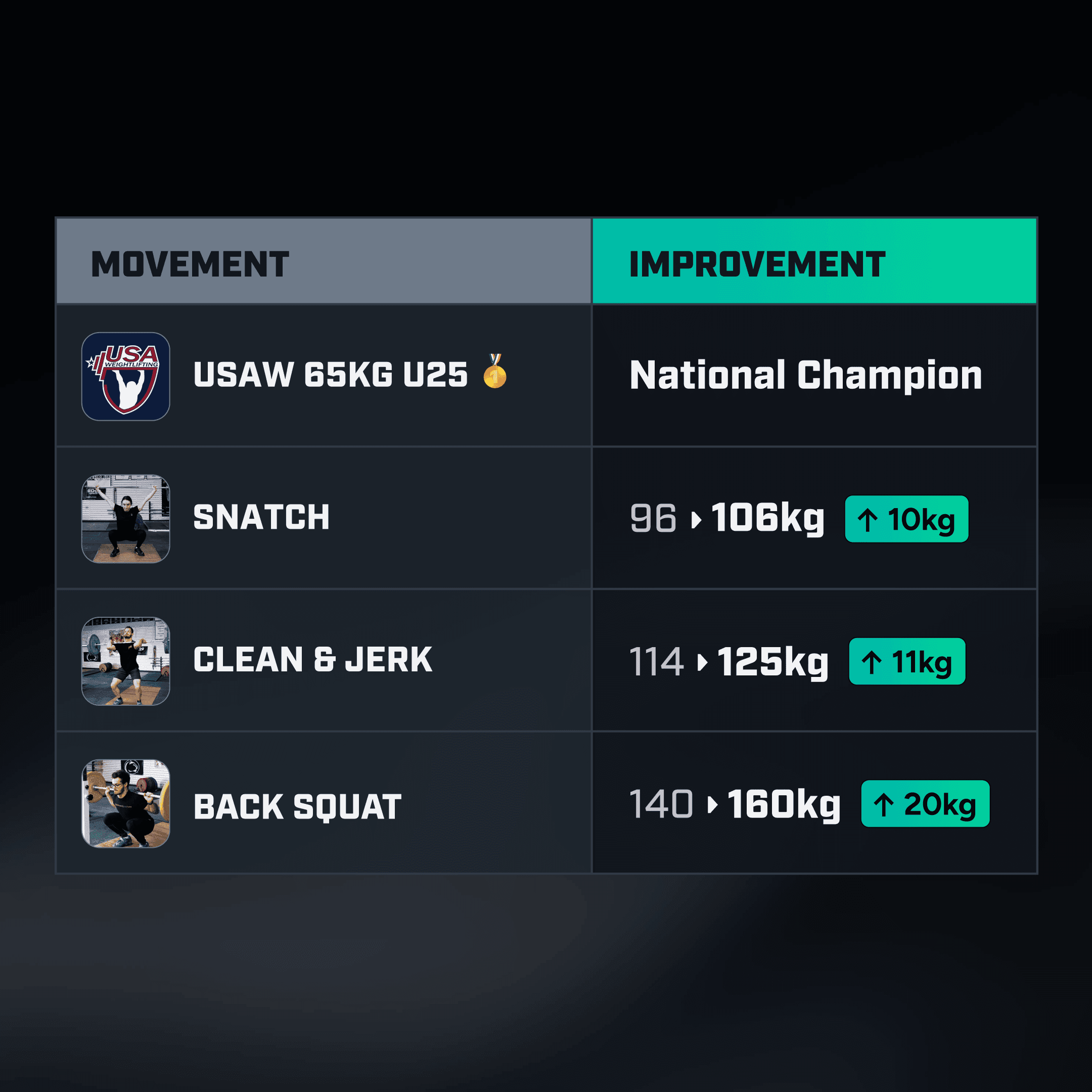
- Back Squat: Increased from 140 kg to 160 kg (+20 kg)
- Snatch: Increased from 96 kg to 106 kg (+10 kg)
- Clean & Jerk: Increased from 114 kg to 125 kg (+11 kg)
These improvements highlight significant gains in lower-body strength, explosive power, and technical consistency in specific lifts all of which are critical for success in Olympic weightlifting. This case study provides a detailed analysis of the athlete’s training program, methodology, and outcomes, demonstrating the effectiveness of following a structured program through the Peak Strength app.
ATHLETE PROFILE
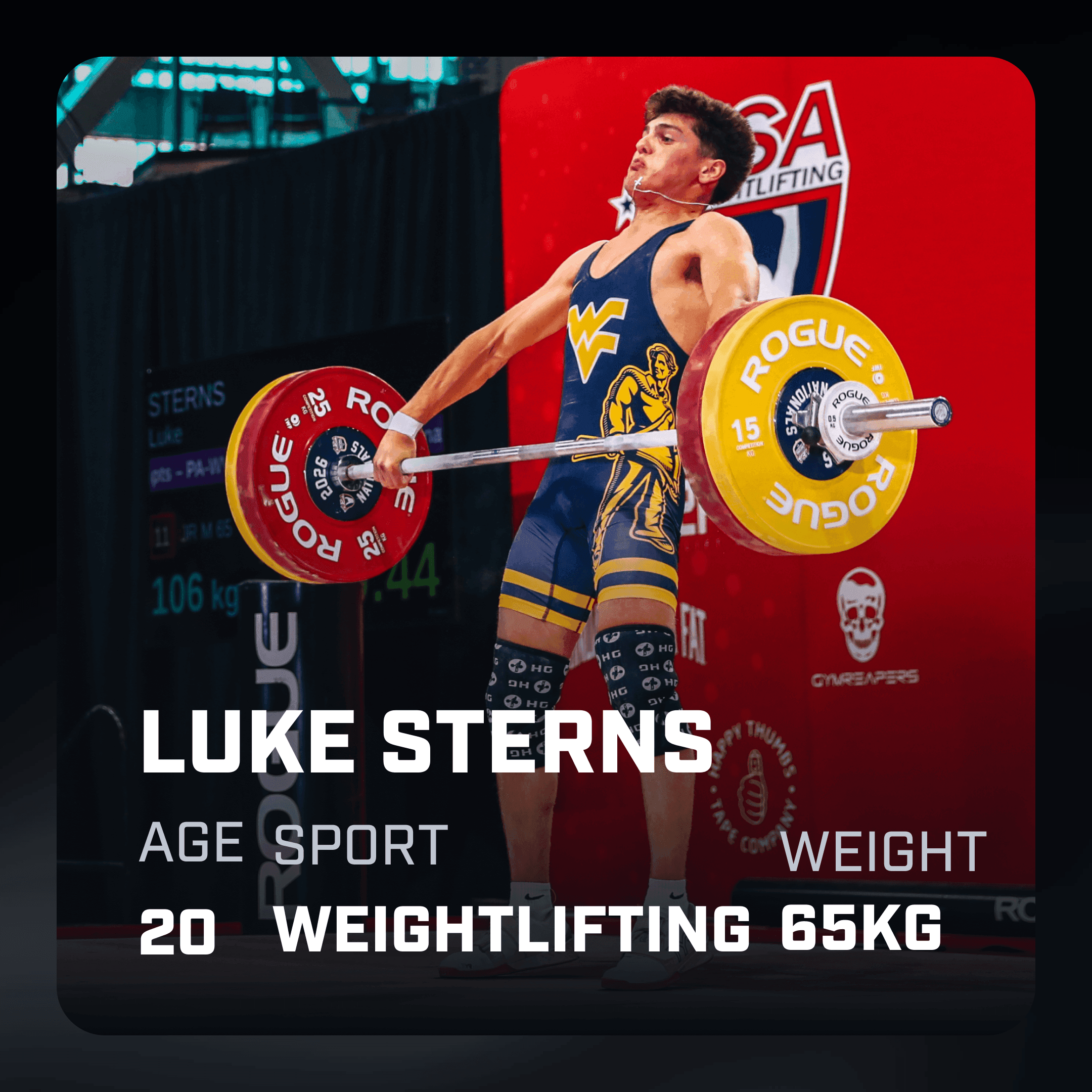
Name: Luke Sterns
Primary Sport: Olympic Weightlifting
Training Duration: 9 months
Frequency: 3-4 training sessions per week
Total Tonnage: 425,000+
Additional Context: Luke formerly trained at Garage Strength under Dane Miller’s programming before attending college at West Virginia University. He has been participating in Olympic weightlifting for 9 years and has previously placed at nationals in the youth division, so he is already considered advanced in terms of training age.
“I think [Peak Strength] is the best app that someone can use to get better at their respective sport.”
TRAINING FOCUS
The athlete’s primary goals were to:
Increase explosiveness and technique for better performance in Olympic weightlifting.
Improve absolute strength to support the demands of his sport.
Improve his results at major Olympic Weightlifting competitions such as University Nationals and the U25 National Championships.
METHODOLOGY
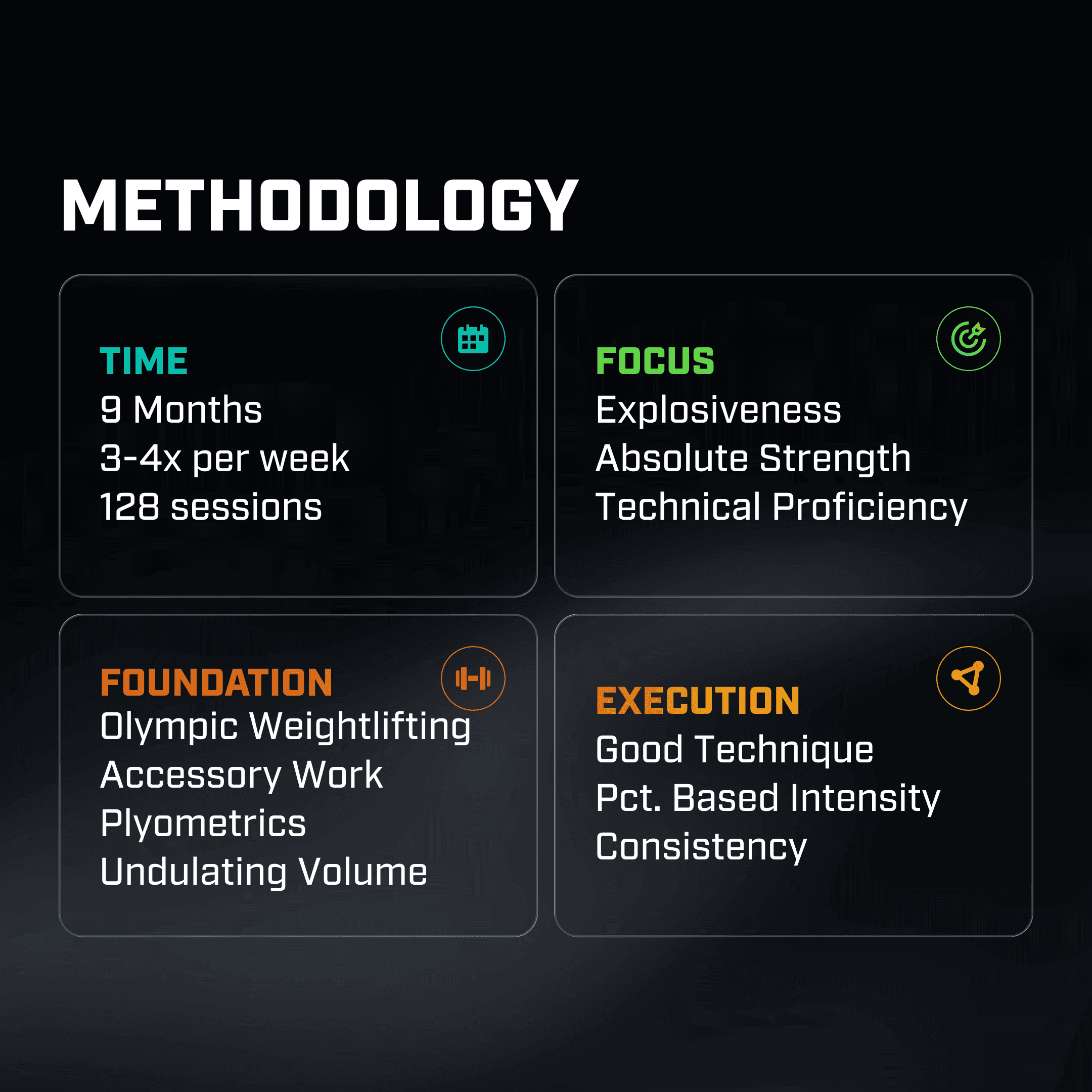
The athlete followed a comprehensive, sport-specific training plan designed to enhance explosiveness and general strength. The program integrated key elements of strength training, Olympic weightlifting, and plyometrics. Each training session included the following components:
Strength Training: Emphasis on back squats, pulls, and posterior chain development.
Olympic Weightlifting: Focused on the competitive movements of snatch and clean and jerk, along with their variations.
Plyometrics: Drills designed to improve movement patterns, balance, and explosiveness.
Accessory Work: Core strengthening exercises, mobility drills, and isolation exercises for hypertrophy.
“Before Peak Strength, I would keep track of my weights in my head and put on the weight I wanted, but it was boring training that way. Through the app, it tells me what to lift and I like that I can keep track of my training sessions.”
TRAINING PROGRESS AND RESULTS
Absolute Strength
.png&w=3840&q=75)
.png&w=3840&q=75)
Back Squat:
Starting Point: 140 kg
End Point: 160 kg
Improvement: +20 kg (14.2% increase)
Analysis: The increase in the back squat demonstrates a significant improvement in lower body strength, which is critical for being able to produce maximal force and maintain stability in Olympic weightlifting. The added squat strength provides a solid foundation for developing the explosive power necessary as training intensity increases closer to a peak date and the ability to execute lifts in a competition setting.
Explosiveness
Snatch:
Starting Point: 96 kg
End Point: 106 kg
Improvement: +10 kg (10.4% increase)
Analysis: The snatch is one of the two competitive lifts in Olympic weightlifting. An improvement of 10 kg over the course of 9 months is a high level of progress for someone that has already been Olympic weightlifting for 9 years. Not many athletes see that level of progress over the course of 9 months, but the focus on proper exercise selection to address technical proficiency and the added strength from back squat supported this gain. Additionally, being able to complete a maximal snatch in a major competition, where pressure plays a role in execution, reinforces the development of technical mechanics.
Clean and Jerk:
Starting Point: 114 kg
End Point: 125 kg
Improvement: +11 kg (9.6% increase)
Analysis: The clean and jerk is the second of the two competitive lifts in Olympic weightlifting. An increase of 11 kg in the clean and jerk is a direct result of the increased intensity and strength from the back squat. Back squat and front squat are key performance indicators in the ability to stand up a clean and produce vertical force to drive a jerk overhead. Again, seeing an almost 10% increase in performance is not very common among already advanced weightlifters unless going up weight classes.
Additional context: Luke did not go up a weight class to 65kg. He competed in the 65kg weight class prior to beginning training on Peak Strength. The gains made in his competitive lifts are a result of numerous factors such as specific weight recommendations, exercise selection, consistent training, and undulating volume targeting a peak date.
TRAINING OBSERVATIONS
Absolute Strength: The strength gains in the back squat (14.2% increase), clean and jerk (9.6% increase), and snatch (10.4% increase) demonstrate substantial improvements in total body strength, which supports not only the technical execution of lifts but also the ability to perform under pressure during competition.
Explosiveness: The athlete’s increased clean and jerk and snatch both point to a significant enhancement in explosive power. This is crucial for the athlete’s performance in the Olympic weightlifting, where the ability to generate force quickly can lead to heavier weights to be achieved in a competition setting.
Technical Consistency: The duration of the training period (9 months) combined with the frequency of technical coordination movements (cleans, snatches, jerks, and variations) throughout each training week allows for consistent practice of competition-specific movements. The length of this period develops the necessary ability and neural capacity to progress in weight in advanced movement patterns.
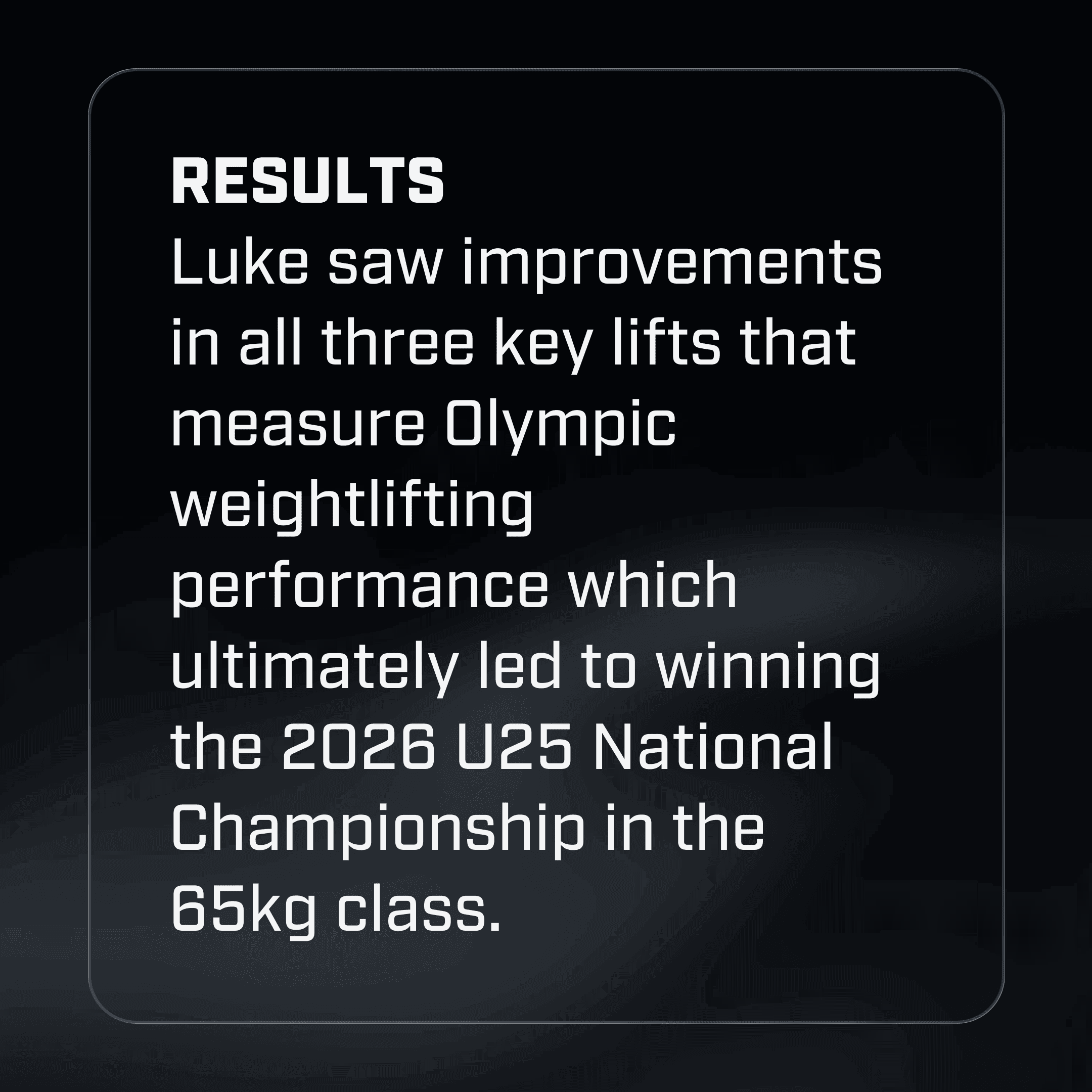
Competition Performance: By focusing on a single training goal of Olympic weightlifting over a 9 month period and spanning various competitions, this prepares the athlete to feel confident in attempting to perform larger competitions. With the current weights being achieved both in training and on the competition platform, Luke was able to secure gold at the USAW U25 National Championship. His total of 231 kg would have earned him 6th place at the Senior National Championship which puts him in contention to earn one of the 12 available spots for the 2027 Senior National Championship.

CONCLUSION
Over the 9-month period, Luke Sterns demonstrated impressive improvements in key strength and explosiveness metrics. With increases in squat strength and Olympic weightlifting movements, the athlete has significantly enhanced his athletic capacity for further training development and improving his competitive ranking in the United States. With the culmination of his training resulting in a 6/6 performance and multiple personal records at the U25 National Championship, Luke is now more motivated than ever to keep pushing the limits of his own abilities in the sport of Olympic weightlifting.
FUTURE RECOMMENDATIONS
Increase Training Volume: Luke has been training only 3-4 times a week to achieve his current results. With his next goal of securing a top-12 ranking in the country so that he can participate in the 2027 Senior National Championship, it would be recommended to train 4-5 times per week. This is so that he can accumulate training volume early in his next training cycle and increase his overall baseline for performance as the volume tapers off and intensity increases closer to his next competition, leading to greater numbers in competition.
Prioritize Absolute Strength: With a back squat of 160 kg at 65kg bodyweight, this puts him at about 2.4X compared to his bodyweight. It is common for elite weightlifters in his weight class to squat close to and above 2.75X their body weight. With a combination of increased training volume and focus on improving his squat closer to 180 kg, this should give him a greater capacity to increase his snatch and clean and jerk weights.
Ivan Escott
Ivan is a national-level Olympic weightlifter and performance coach at Garage Strength Sports Performance.